Kansas City Star Article Ob Dreams of the Kings a Nelsonatkins Museum of Art
William Rockhill Nelson and Mary McAfee Atkins never met, merely they shared an important dream: a fine art gallery for Kansas City. Decades afterward their deaths, the trust funds from their estates combined to create a museum and so magnificent that it surely would have pleased them both. Information technology would take more than than 20 years of planning, work, and civic involvement to transform the vision of these two Kansas Citians into reality.
Mary McAfee Atkins, the reclusive widow of a pioneer real-estate dealer, had been inspired by a visit to the dandy European galleries during the last years of her life. When she died in 1911, she left most $300,000 of her manor for the construction of a gallery building.
William Rockhill Nelson, owner and editor-in-chief of The Kansas City Star and Times, had been similarly moved past a trip to Europe in 1896. Convinced that a truly cultivated city needed an art collection, he purchased fine reproductions of famous paintings as the intended nucleus of a gallery collection. When he died in 1915 he left a trust fund of about $xi 1000000 for purchasing more than fine art. His widow, daughter, son-in-law, and family lawyer apparently caught his enthusiasm, for their wills left funds for a museum to house the collection Nelson dreamed of. Through daughter Laura Nelson Kirkwood and her husband Irwin, the city also gained the Nelson's 20-acre Oak Hall estate for a futurity gallery site.
When the Oak Hall estate became metropolis property in 1927, Atkins' trustees had been planning to build a small gallery on the Freedom Memorial mall, simply they and five other groups of trustees from the Nelson and Kirkwood estates realized that they were pursuing similar intents. Recognizing that a grander gallery could be accomplished past joint effort, they decided to pool their resource and work together.
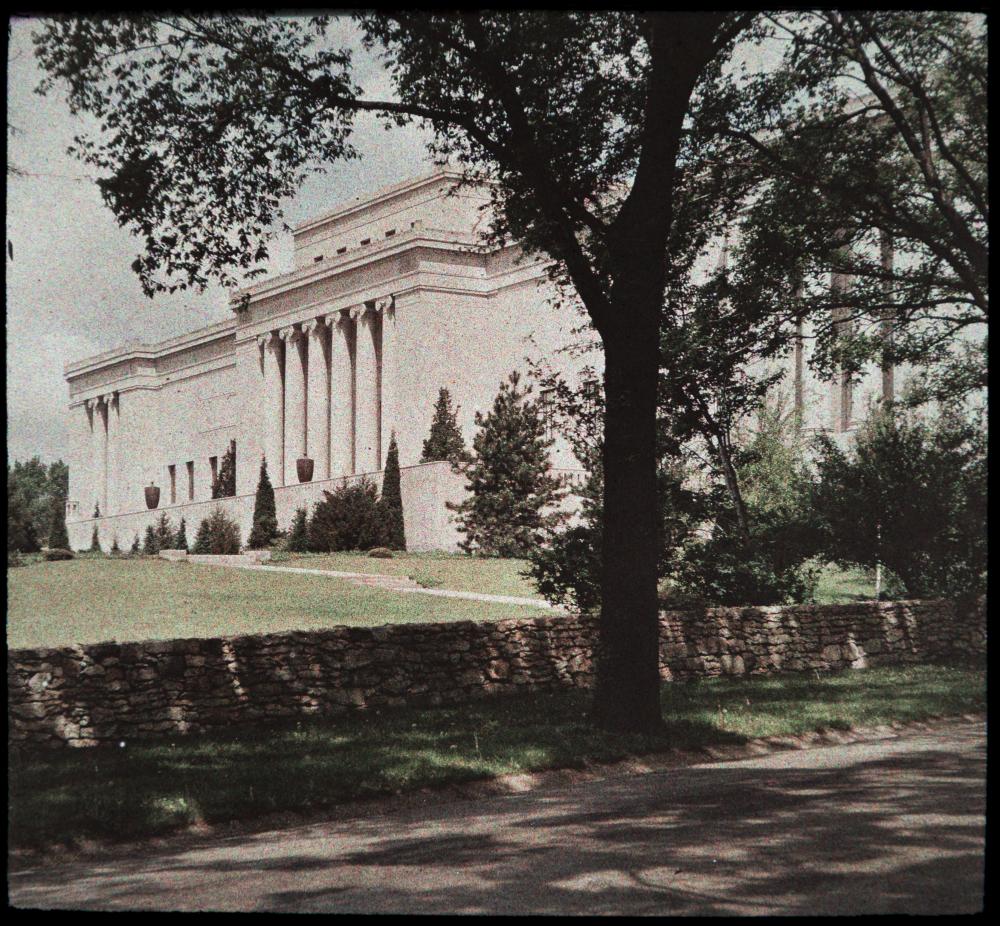
Wight & Wight, the near prestigious architectural firm in Kansas Urban center, designed the new gallery. Irwin Kirkwood's volition had specified a neoclassical design and a building textile of Indiana limestone. The neoclassical design, with its central portico supported by Greek columns, also reflected so-electric current tastes in fine art museum architecture. Classical architecture was idea to embody the permanence of artistic values and suggest both a monument and a temple to art. Wight & Wight'south pattern too incorporated ideas from their studies in Greece and Italy and from other museums. Their most direct influence was probably the Cleveland Museum of Fine art, from which they borrowed elements of the neoclassical design, the setting on a prominent loma, and the garden court (Rozzelle Court).
With the site and architects selected, the gallery project moved quickly. The first stages of construction began with the razing of Oak Hall in the spring of 1928, in keeping with Laura Nelson Kirkwood's will. Although anticipating the much-needed public institution that would occupy the spot, both the public and the Star mourned the loss of this cute native-stone landmark.
Groundbreaking began in July 1930, the cornerstones were laid in the bound of 1931, and by the fall of 1932 the outside was complete. The imposing structure, six stories high and larger than a city block, cost $ii.75 meg. The eastward fly would be the Atkins Museum and the due west wing the Nelson Gallery of Art. The first and second floors of the due west fly would exist left unfinished to run across futurity demands. It would accept another year to complete the interior and collect and install the fine art.
During that year, R. A. The netherlands, the starting time curator of collections, and other experts assembled a permanent painting collection spanning six centuries. The first 10 paintings, acquired in 1930 from a local fine art house, consisted of portraits by artists of the English eighteenth-century school. The overall goal was to create a general historical drove rather than objects from a detail region or period.
The art in place, Nelson Gallery of Fine art and Atkins Museum opened to the public December 11, 1933. Information technology rated loftier praise in national-circulation magazines and newspapers, which exclaimed over the opulence of the building, the cute landscaping, the outstanding art collection, and the state-of-the-art lighting and ventilation techniques. In the showtime twelvemonth attendance totaled most 315,000, an average of more than one,000 visitors per day.
The first sight to greet visitors' eyes were the 32 gigantic columns, each 40 anxiety high and 5 feet in bore, that ornamented the four facades. The rest of the facade featured rich decorative and symbolic item. Inscribed quotations on the friezes of each façade—from the works of Michelangelo, Victor Hugo, and others—sounded the theme of art every bit enduring beauty and eternal reason. Kickoff on the exterior of the due east façade, sculptor Charles Keck created a series of 23 limestone panels depicting the march of civilisation from east to west. The panels depicted such scenes as trappers, traders, scouts, and wagon trains heading w from Westport Landing. The 24 panels of the bronze eastward side doors present dramatic passages from Longfellow'southward verse form "Hiawatha." The grillwork around the south and east doors depicted the zodiacal nascency signs of the Nelsons and Irwin Kirkwood, with oak-leafage motifs added in retentivity of Oak Hall.
The landscaping by Hare & Hare, the pre-eminent landscape architectural firm of Kansas City, matched the building in grandeur. The landscape architects were proponents of the Urban center Beautiful Motility, which emphasized preserving and enhancing the natural mural rather than imposing a new or rigid order upon it. The mural architects planted additional 200 copse around the museum, placed plantings to subtly pb the eye through walks and views toward the building, and added walkways and rock walls that conformed to the natural terrain.
The interior ornamentation received the same care given to the exterior and the grounds. Wight & Wight blended native materials and Midwestern themes with classical motifs and European marbles throughout. Visitors entering the north main entrance entered a formal vestibule into Kirkwood Hall, resplendent with 12, 30-foot-tall blackness Pyrenees marble columns and tapestry-covered walls. Polished golden pillars of Missouri marble separated Kirkwood Hall from galleries at either end of the building.
In i of the finest examples, William Wight designed the south lobby to resemble a fifteenth-century villa he had sketched when studying in Italia. The arched and domed foyer juxtaposed native "Kacimo" marble, a variegated native rock polished to a marble finish, with paintings by local artist Daniel MacMorris. MacMorris used a palette and bailiwick matter reminiscent of high Renaissance Italian painting and painted the signs of the zodiac inside connecting medallions for an added Renaissance season.
The 90-foot-foursquare Rozzelle Court, named for the Nelson family lawyer and donor Frank Rozzelle, received a similar treatment. Columns and arches reminiscent of fifteenth-century Italy were blended with walls, floors, and columns of Mankato stone quarried in Michigan. The heart of the courtyard featured a huge light-green marble bowl taken from the Roman baths.
In another splendid bear upon, a grand marble stairway in Atkins Museum swept from the due east doors to the primary floor of exhibition rooms. Higher up it were murals by painter Andrew Schwartz representing the progress of civilization in mastering the arts, from prehistoric times through the Italian Renaissance.
The setting was a fitting complement to the real pieces de resistance, the fine art itself. The art was showcased in a series of 50 small exhibit rooms or galleries, grouped by century and national origin, and arranged in chronological order. Gallery one displayed religious paintings from the Centre Ages, for example, and other rooms featured fifteenth-century Italian and nineteenth-century French art. Each room contained no more than 10 or 12 paintings, allowing aplenty infinite for viewing while providing a sense of intimacy. The exhibit rooms were interspersed with galleries for special exhibits and rooms decorated to represent various eras, assuasive visitors to step into part of a Chinese temple or a colonial American farmhouse.
In contrast to the historic nature of its collection and surrounding, 1 of the most impressive features of the museum was its modern brandish and conservation technology. A unique artificial lighting organization created an aquarium-similar consequence by tucking lighting into recessed areas within the walls, eaves, and neutral glass ceilings of darkened rooms. A land-of-the-art heating and cooling system kept temperatures and humidity constant to protect the artwork and filtered air throughout the museum.
Over the decades the museum and gallery accept been gradually enlarged and enhanced. Upon opening, about 1-third of the due west wing had been left unfinished for future expansion. In April 1941 part of the starting time and second floors of the west wings were completed. Half dozen new galleries opened, including one for Chinese painting and sculpture, and a "Classical Hall." Afterwards Globe War II, the rest of the get-go floor was completed with the addition of 7 new rooms, including a Castilian Baroque chapel and an English Tudor room.
In 1999, when it was clear that the museum had outgrown its infinite, Nelson-Atkins leaders planned for a building addition. Their Architect Selection Commission chose internationally known New York architect Steven Holl, who intrigued the committee with his innovative design for a new building on the east side of the museum rather than a building addition.
To contrast with the heavy rock Nelson-Atkins edifice, Holl designed a light "plumage" of a edifice, an elongated shape consisting of 5 drinking glass "lenses" alternately obscured and revealed by the landscape. A grassy area between and sometimes atop the glass lenses allows visitors to stroll along the rooftop of the edifice. The exterior features translucent glass walls that refract and curve sunlight during the day and illuminate the building from within at night. A reflecting pool on the north side ties together the 2 distinctive buildings. Unveiled on June 9, 2007, the building was named in honor of Henry W. and Marion H. Bloch, "whose dedication and vision helped transform the Nelson-Atkins."
The existing museum edifice was besides upgraded and renovated, providing room for more displays, special exhibits, and community education programs.
Source: https://pendergastkc.org/article/buildings-orgs/nelson-atkins-museum-art
0 Response to "Kansas City Star Article Ob Dreams of the Kings a Nelsonatkins Museum of Art"
Post a Comment